Today when I logged in to look at my blog, Chrome had it flagged as a deceptive site. It is not a deceptive site, I have had this blog for over a decade. I'll have to look into it to see what the issue is.
Wednesday, November 16, 2022

Tuesday, March 2, 2021
Soap!
Normally we tend to prefer making large, rustic bars of soap, with less concern for the appearance of the soap, and more attention to ingredients and lather. Usually, the soap is poured into five-pound loaf molds and cut into generous slices which can be cut down into smaller sizes. Sometimes, we make smaller bars or use molds in different shapes.
What we've been up to lately:
 |
| Hot Cocoa Salt |
Salt bars are soaps that contain a high percentage of salt, often as high as 50%. It's sort of like a salt scrub in bar form. They are nice at the kitchen or mudroom sink and great for use after gardening. Salt bars should not be used to wash cut or broken skin, because the salt can cause stinging.
The Hot Cocoa Salt bars have a mild scent reminiscent of hot chocolate and are topped with espresso powder and coarse sea salt. Some are decorated with a single coffee bean. The ingredients are Babassu Oil, Coconut oil, Castor Oil, Cocoa Butter, Pomace Olive Oil, Sodium Hydroxide, (processed into soap), Himalayan Salt, Coffee Grounds, Cocoa Powder, Fragrance. Decorated with Sea Salt, Himalayan Salt, Espresso Powder, and Coffee Beans.
 |
| All Spruced Up |
This soap was made using the hot process method. In the hot process method, the soap solution is heated to accelerate saponification. After saponification but while the solution is still fluid, fragrance ingredients are added. We do it this way because prior to saponification, the solution is at a very high ph, which may alter the quality of some of the ingredients. After saponification, the ph is a bit lower. The hot process method tends to create a more rustic appearance to the soap, but we prefer it because we think it generally yields a better quality scent.
The soap has an invigorating spruce scent. We added different plant materials in layers to create various shades of green and topped it with a layer tinted with green oxide. The different layers are reminiscent of the sensation of walking through a forest, with different layers of vegetation underfoot. The ingredients are Coconut Oil, Sustainable Palm Oil, Castor Oil, Cocoa Butter, Refined Rice Bran Oil, Pomace Olive Oil, Shea Butter, Sodium Hydroxide, (processed into soap) Yogurt, French green clay, essential oils of Spruce, Cedar, Amyris, and Pine, also contains Spirulina, Chlorella, Alfalfa Leaf, Mica, Fragrance, Sea Salt, Sugar, Tussah Silk, Sodium Lactate, and Vitamin E T50.
 |
| Golden Mimosa |
Golden Mimosa was created for a pampered bathtime experience. It contains mimosa floral wax and mango seed butter and is scented with notes of mimosa, sandalwood, and ambergris. When you look at the soap, you may see a white film in places. This film is called soda ash and sometimes occurs naturally while handcrafted soap is curing. Many soapmakers go to great lengths to formulate their soap to avoid soda ash, or they may rinse it off after the soap is cured. Our practice at this time is to leave it on - it doesn't harm anything, and it rinses off easily during the first use, and it demonstrates that this is truly a handcrafted soap.
Ingredients: Oils of Olive, Coconut, Sustainable Organic Palm, Castor; Mango Seed Butter, Sodium Hydroxide, (processed into soap,) Mimosa Wax, Sandalwood Essential oil, Vitamin E T-50, Fragrance
 |
| Eventide |
Scented with Jasmine
Sambac Wax, Jasmine Grandiflorum Wax,
Ylang Ylang Essential Oil, Frankincense Essential Oil, Pink Grapefruit
Essential Oil, Petitgrain Essential Oil, Patchouli Essential Oil, Mandarin
Essential Oil, and Jasmine Essential Oil, this soap is superfatted with luxurious Mowrah Butter. It's perfect for a special night, or just for
special pampering.
Ingredients: Olive Oil, Coconut Oil, Mowrah Butter, Sunflower Oil, Castor Oil, Sodium Hydroxide, Sweet Woodruff, (processed into soap) Jasmine Sambac Wax, Jasmine Grandiflorum Wax, Essential Oils of Ylang Ylang, Frankincense, Pink Grapefruit, Petitgrain, Patchouli, Mandarin, Jasmine Also contains Fragrance, Sea Salt, and Vitamin E T50
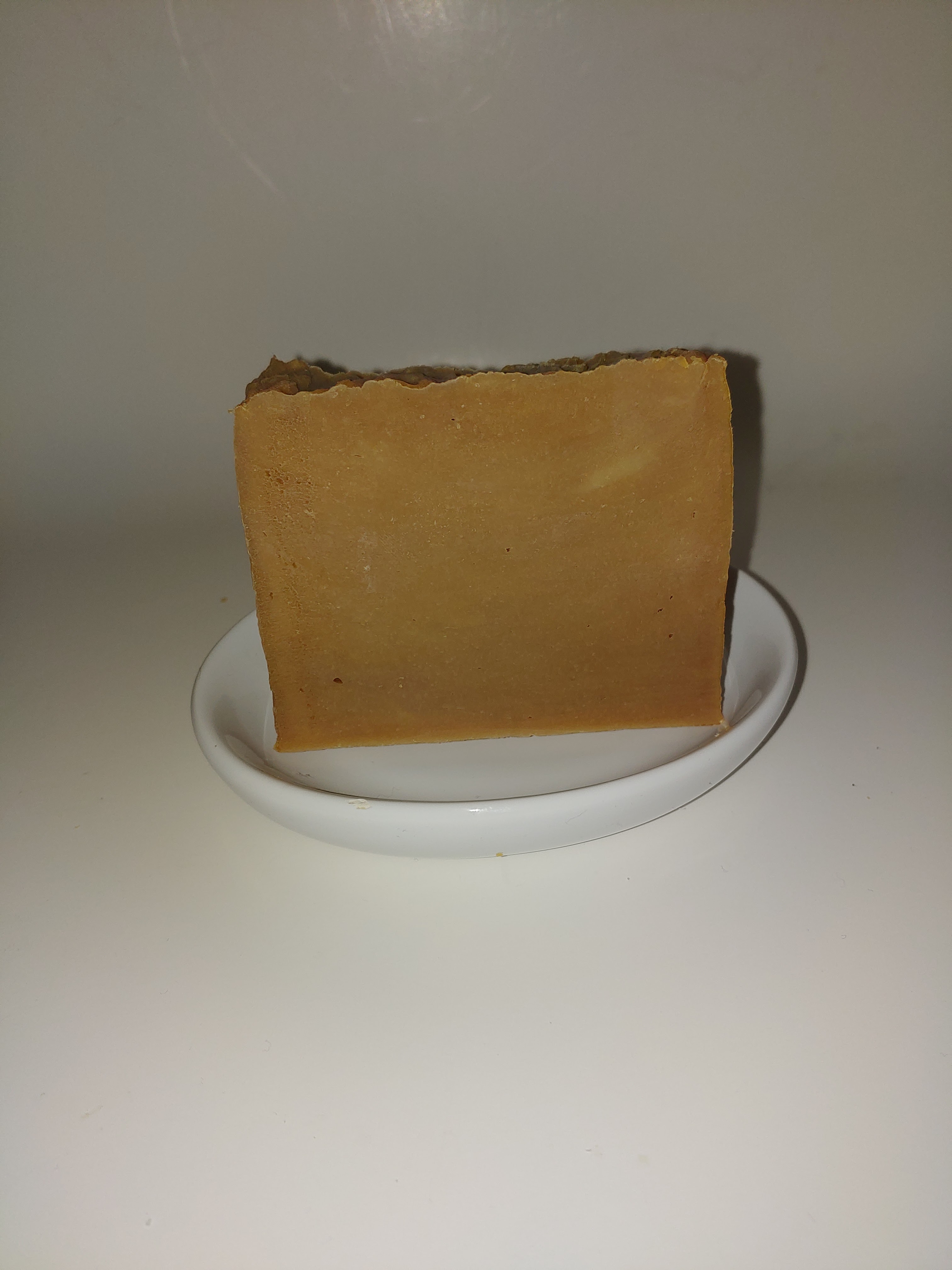 |
| Unconquered Sun |
Unconquered Sun has a mild evergreen scent with a hint of clove and citrus. Ingredients: Oils of Coconut, Olive, Castor, Palm, Shea butter, Sodium Hydroxide, (processed into soap,) Glycerin, Essential Oils of Orange, Frankincense, Bay Laurel, Myrrh, Vanilla, Juniper Berry, Fir Needle, Pine Needle, Nutmeg, Clove, Vitamin E T-50, Salt
 |
| Pumpkin Swirl |
This soap was made with pumpkin puree and was poured into a mold with a Celtic knot design. It smells like pumpkin spice. Ingredients: Oils of Coconut, Olive, Sunflower, Castor, RedPalm, Shea butter, Sodium Hydroxide, (processed into soap,) Pumpkin Puree, Pumpkin Pie Spices, Essential Oils of Orange, Clove Bud, Frankincense and Vanilla, Vitamin E T-50, Fragrance Oils, Salt
 |
| HHGB |
This soap has a woodsy, earthy, almost smoky scent. Similar to King of the May, but much earthier and more primal. Ingredients: Olive Oil, Coconut Oil, Shea Butter, Sunflower Oil, Castor Oil, Sodium Hydroxide, Sweet Woodruff, (processed into soap) Essential oils of Fir, Rosewood, Pine, Sage, Coriander, Katrafay, Rosemary, White Thyme, Cajeput, Cedarwood, Birch Tar, Benzoin, Copaiba Balsam, Vetiver, Patchouli, Myrrh, Vanilla, Frankincense, also contains Fragrance, Sea Salt, and Vitamin E T50
 |
| Honor Bars |
 |
| Queen of the May |
 |
| Mayflower |
Light floral fragrance. Ingredients: Oils of Coconut, Olive, Shea Butter, Castor, Sodium Hydroxide, (processed into soap,) Fragrance Oils, Vitamin E T-50
 |
| King of the May |
King of the May has a woodsy, earthy scent. Ingredients: Oils of Olive, Coconut, Sunflower, Castor, Shea Butter, Sodium Hydroxide, (processed into soap) Crushed Dried Sweet Woodruff Herb, Essential Oils of Frankincense, Sandalwood, Cedar Wood, Benzoin, Vetiver, Pine, Sage, Vanilla, Geranium, Ylang-Ylang Vitamin E T-50, Fragrance oils of Oakmoss and Sandalwood
 |
| Desert Seeker: Goat's Milk Bar and Shave Bar |
Desert Seeker is a masculine scent, with notes of musk and desert creosote. It's available in a goat's milk hand and body bar, and in a shave soap, and is available as a set or individually. You may notice the soda ash on one end of the goat's milk bar. This occurs naturally during the curing process and will rinse off right away the first time the soap is used.
Desert Seeker Goat's Milk ingredients: Ingredients: Oils of Olive, Coconut, Sustainable Organic Palm, Castor; Goat’s Milk, Sodium Hydroxide, (processed into soap,) Fragrant Oil
Desert Seeker Shave Ingredients: Ingredients: Sustainable Organic Palm Oils, Castor Oil, Coconut Oil, Pomace Oil Oil, Shea Butter, Sunflower Oil, Jojoba Oil, Sodium Hydroxide, (processed into soap,) Sodium Lactate, Sugar, Vitamin E T -50, Fragrant Oil
 |
| Mighty Lugh: Full Sized Bath, Half Sized Bath, Salt Bar, and Shave Bar |
Mighty Lugh was intended as a masculine scent, but some describe it as unisex. It has notes of green apple, apple blossom, lavender, and oak. It's available in a set or individually. You may notice that the salt bar looks uneven and rustic. This is because salt bars harden very quickly after they are poured and can be a challenge to cut evenly. The round shave bar is a slightly different color than the rest, due to the addition of Bentonite Clay.
Mightly Lugh Ingredients: Pomace Olive Oil, Organic Sustainable Palm Oil, Coconut Oil, Sunflower Oil, Castor Oil, Shea Butter Jojoba Oil, (Processed into soap with Sodium Hydroxide), Essential oils of Frankincense and Lavender, Vitamin E T-50, Fragrance
Mighty Lugh Salt: Ingredients: Organic Coconut Oil, Castor Oil, Organic Sunflower Oil (Processed into soap with Sodium Hydroxide), Sea Salt, Vegetable Glycerin, Essential oils of Frankincense and Lavender, Vitamin E T-50, Fragrance
Mighty Lugh Shave: Ingredients: Coconut Oil, Pomace Olive Oil, Castor Oil, Sustainable Organic Palm Oil, Shea Butter, Sunflower Oil, Jojoba Oil, Sodium Hydroxide, (processed into soap,) Bentonite Clay, Glycerin, Lavender Essential Oil, Frankincense Essential Oil, Fragrant Oil, Sugar, Sodium Lactate, Vitamin E T -50
 |
| Random, Ugly and Naked, aka Runner Bars |
When you love to make soap as much as we do, you are bound to have a lot of leftovers. Some pieces are more misshapen than our usual rustic bars or have larger air bubbles. They may be the last lonely piece left out of a batch or the scent may have faded. Sometimes when we are developing new formulas, we will create test batches, trying several ingredients from different sources until we find the perfect one. They wind up in a bin without labels. The soap is still wonderful and mild, it's just... random, ugly, and naked.
Saturday, June 1, 2019
Ingredients matter: Controversial Ingredients in Bath and Body Products
One of the reasons that people buy handcrafted bath and body products is to avoid synthetic chemicals. I've been quite through a few phases during my soap-making journey, and one phase was "crunchy granola earth mama." I was convinced that only "all-natural" is the way to go and that anything with chemicals was inferior at best and dangerous at worst. While I still love mother nature and appreciate the natural aesthetic, I do feel that man-made and lab-created ingredients have their place. That doesn't mean that ingredients don't matter. But there is more to it than natural vs. synthetic. One might also consider whether the ingredient is healthy, ecologically friendly, or wildlife friendly.
Essential oils and other Plant Materials:
Essential oils are natural oils that are made by distilling plant material, which involves heat. It takes a large amount of plant material to make a small quantity of essential oils. The oil generally will smell like the plant material, for example, orange essential oils smell like oranges. Not all plant material can be used to create an essential oil that smells like the plant. For example, material from the strawberry plant will not make an essential oil that smells like strawberries. Not all plant materials will retain their fragrance in the distillation process, because the heat changes the chemical structure of the plant material.
People assume that because essential oils are natural, they are always safe and healthy for everyone, but that is not the case. Certain essential oils are contraindicated for people with certain health conditions or can be harmful to pregnant women or young children. Some people are allergic to essential oils. Some essential oils can cause irritation, particularly if they are not properly diluted. In the case of cancer patients, some essential oils need to be avoided during a period of time leading up to and after chemotherapy. Certain essential oils cause something called phototoxicity, which causes increased sensitivity to sun exposure, causing sunburn and a rash. Sun exposure should be avoided for several hours after using these oils. It is true that soap is a wash-off product, so the concern about things like drug interaction and photosensitivity not as high, because most of the essential oils go down the drain with the dirt. However, it can be difficult to determine how much exposure is "safe."
Some essential oils are extremely expensive, such as rose, jasmine, and sandalwood, and it might seem a waste to put expensive oils in a soap that will just be lathered up and rinsed down the drain. Some wild plants are at risk of becoming endangered due to over-harvesting for essential oils. To me, this means that sometimes we can love nature and love ourselves when we use synthetic materials safely and prudently. While fragrance oils are not therapeutic, there are advantages to the proper use of fragrance oils.
Here is an excellent comment on essential oils and chemotherapy, by one of the leading essential oil experts: Frankincense essential oil and cancer: Why EOs and chemotherapy don't always mix
Here's a pretty comprehensive article on essentials oils for cancer patients:
Aromatherapy With Essential OIls
Here is a pretty good description of some reasons to use fragrance oils:
and another:
A Complete Guide To Natural, Organic & Synthetic Fragrances
Chanel is famous for growing their own flower fields to make their perfume. Take a look at how much Chanel sells a bar of soap for - $26.00!
Chanel N5
Distillation is only one form of fragrance extraction from plants. Others are solvent extraction, expression, sieving, or enfleurage.
Solvent extraction is often used when a plant material cannot withstand distillation. The fragrance is extracted using a solvent such as hexane, ethanol, or carbon dioxide. After the fragrance is extracted from the plant material, the solvent is removed from the material, leaving behind an ingredient called concretes, absolutes, or tinctures. People have told me that they avoid concretes because they are made using hexane, which is toxic and carcinogenic. This is true. Hexane is toxic and carcinogenic - it's very harmful to inhale pure hexane. However, in the concrete material, the amount of hexane left behind is minute - in parts per million - and the real risk of exposure is to the people who are using the hexane to make concretes. Would I use a perfume that contains concretes? Yes, probably, even when avoiding carcinogenic substances, because the amount of hexane left behind is too small to cause concern in day-to-day perfume use. Would I accept a job working with hexane to make concretes? Yes, as long as I am confident that the safety equipment that I am using and the procedures I am following are sufficient to protect my health
"Expression" simply means that the material is squeezed to release the oils. This is most common with citrus oils.
Enfleurage and maceration involve blending the plant material with fats or grease. With maceration, the fragrance is extracted from the fat using alcohol.
Usually, most of these methods are used in perfume blends but can be cost-prohibitive in soap.
Essential oils and other Plant Materials:
Essential oils are natural oils that are made by distilling plant material, which involves heat. It takes a large amount of plant material to make a small quantity of essential oils. The oil generally will smell like the plant material, for example, orange essential oils smell like oranges. Not all plant material can be used to create an essential oil that smells like the plant. For example, material from the strawberry plant will not make an essential oil that smells like strawberries. Not all plant materials will retain their fragrance in the distillation process, because the heat changes the chemical structure of the plant material.
People assume that because essential oils are natural, they are always safe and healthy for everyone, but that is not the case. Certain essential oils are contraindicated for people with certain health conditions or can be harmful to pregnant women or young children. Some people are allergic to essential oils. Some essential oils can cause irritation, particularly if they are not properly diluted. In the case of cancer patients, some essential oils need to be avoided during a period of time leading up to and after chemotherapy. Certain essential oils cause something called phototoxicity, which causes increased sensitivity to sun exposure, causing sunburn and a rash. Sun exposure should be avoided for several hours after using these oils. It is true that soap is a wash-off product, so the concern about things like drug interaction and photosensitivity not as high, because most of the essential oils go down the drain with the dirt. However, it can be difficult to determine how much exposure is "safe."
Some essential oils are extremely expensive, such as rose, jasmine, and sandalwood, and it might seem a waste to put expensive oils in a soap that will just be lathered up and rinsed down the drain. Some wild plants are at risk of becoming endangered due to over-harvesting for essential oils. To me, this means that sometimes we can love nature and love ourselves when we use synthetic materials safely and prudently. While fragrance oils are not therapeutic, there are advantages to the proper use of fragrance oils.
Here is an excellent comment on essential oils and chemotherapy, by one of the leading essential oil experts: Frankincense essential oil and cancer: Why EOs and chemotherapy don't always mix
Here's a pretty comprehensive article on essentials oils for cancer patients:
Aromatherapy With Essential OIls
Here is a pretty good description of some reasons to use fragrance oils:
and another:
A Complete Guide To Natural, Organic & Synthetic Fragrances
Chanel is famous for growing their own flower fields to make their perfume. Take a look at how much Chanel sells a bar of soap for - $26.00!
Chanel N5
Distillation is only one form of fragrance extraction from plants. Others are solvent extraction, expression, sieving, or enfleurage.
Solvent extraction is often used when a plant material cannot withstand distillation. The fragrance is extracted using a solvent such as hexane, ethanol, or carbon dioxide. After the fragrance is extracted from the plant material, the solvent is removed from the material, leaving behind an ingredient called concretes, absolutes, or tinctures. People have told me that they avoid concretes because they are made using hexane, which is toxic and carcinogenic. This is true. Hexane is toxic and carcinogenic - it's very harmful to inhale pure hexane. However, in the concrete material, the amount of hexane left behind is minute - in parts per million - and the real risk of exposure is to the people who are using the hexane to make concretes. Would I use a perfume that contains concretes? Yes, probably, even when avoiding carcinogenic substances, because the amount of hexane left behind is too small to cause concern in day-to-day perfume use. Would I accept a job working with hexane to make concretes? Yes, as long as I am confident that the safety equipment that I am using and the procedures I am following are sufficient to protect my health
"Expression" simply means that the material is squeezed to release the oils. This is most common with citrus oils.
Enfleurage and maceration involve blending the plant material with fats or grease. With maceration, the fragrance is extracted from the fat using alcohol.
Usually, most of these methods are used in perfume blends but can be cost-prohibitive in soap.
Fragrance Oils
Fragrance oils are materials that contain both synthetics natural compounds. They are popular in soaps and other bath and body products for several reasons. One is that fragrance oils can be found in fragrances that cannot be obtained from distillation, expression, or enfleurage, such as strawberry scent, or "ocean breeze." This creates a wider range of possibilities for fragrance, like having more colors in the crayon box. Another reason that fragrance oils are popular is that can tend to be far more affordable than essential oils, concretes, plant waxes, and absolutes. They can be blended with natural compounds, creating endless possibilities. If a person wishes to avoid an essential oil for health reasons such as chemotherapy, they can enjoy still enjoy scents in their bath and body products.
Fragrance oils are materials that contain both synthetics natural compounds. They are popular in soaps and other bath and body products for several reasons. One is that fragrance oils can be found in fragrances that cannot be obtained from distillation, expression, or enfleurage, such as strawberry scent, or "ocean breeze." This creates a wider range of possibilities for fragrance, like having more colors in the crayon box. Another reason that fragrance oils are popular is that can tend to be far more affordable than essential oils, concretes, plant waxes, and absolutes. They can be blended with natural compounds, creating endless possibilities. If a person wishes to avoid an essential oil for health reasons such as chemotherapy, they can enjoy still enjoy scents in their bath and body products.
Phthalates:
Fragrance oils are also controversial because they may contain phthalates. Phthalates are a large group of chemicals that are used to soften plastic, (they are even used to soften plastic baby toys,) and are used as solvents. They are often used to improve fragrance oils. They are pervasive and found in everything from car upholstery to sneakers. They have found to be linked to obesity, male infertility, and asthma. They are regulated to be used within levels that are determined to be safe, but my issue with them is that while they may be in safe levels in each individual product, I don't know the cumulative impact they have when they are in almost everything. More research is needed to understand the impact of phthalates.
Fragrance oils are also controversial because they may contain phthalates. Phthalates are a large group of chemicals that are used to soften plastic, (they are even used to soften plastic baby toys,) and are used as solvents. They are often used to improve fragrance oils. They are pervasive and found in everything from car upholstery to sneakers. They have found to be linked to obesity, male infertility, and asthma. They are regulated to be used within levels that are determined to be safe, but my issue with them is that while they may be in safe levels in each individual product, I don't know the cumulative impact they have when they are in almost everything. More research is needed to understand the impact of phthalates.
Several years ago in the online communities, soap makers began to discuss phthalates in the fragrance ingredients they were using to make soap. As a result of the discussions, the fragrance vendors began to list their phthalate free fragrances on their websites. Later, some of these companies began offering only phthalate free fragrances. I only purchase phthalate free fragrance, but if someone wanted me to make them a soap using a fragrance that contains phthalate, I would be comfortable purchasing the fragrance and making soap with it, as long as we have a conversation about it. On the other hand, if I can make soap without it, why wouldn't I?
Here's a great article about phthalates:
Phthalates are everywhere, and the health risks are worrying. How bad are they really?
Here's a great article about phthalates:
Phthalates are everywhere, and the health risks are worrying. How bad are they really?
Parabens:
Preservatives are another potentially controversial ingredient. Preservatives are not used in bar soaps, but they must be added to any personal care product that contains water. Whenever a bath, skin, or hair product contains any water, there is a danger of toxic bacteria growing in the product, and this can lead to serious health problems. Unfortunately, the most common preservative, paraben, has been linked to cancer. Currently, the amount of paraben which is added to products is deemed safe, but the cumulative effect of using products containing paraben is not understood. It is possible to find paraben-free products that simply contain a different type of preservative, but these may have a shorter shelf life, so after six months to a year, it's best to discard these products. Parabens are said to increase shelf life for up to two years. When I make bath and body products that need to contain a preservative, I use paraben-free preservatives.
Here is my personal view on parabens: If someone I loved had a history of cancer, I would probably encourage them to avoid parabens as much as possible. They can't be completely avoided though. If your family member had a history of skin cancer, and you were stranded in the middle of the desert without sunblock, and the only store that sold sunblock within 100 miles had one brand of sunblock with parabens in it, would you risk another sunburn, or use the sunblock? I know what I would do. I think that for me, if there were two otherwise equal products, but one was paraben-free, I would choose the paraben-free product, as long as it wasn't expired. Otherwise, I would use the product that contains parabens. As a woman, sometimes I want to wear makeup, and it can be a challenge to find a product that works for me that is also free of parabens.
Detergents and Surfactants:
Here is my personal view on parabens: If someone I loved had a history of cancer, I would probably encourage them to avoid parabens as much as possible. They can't be completely avoided though. If your family member had a history of skin cancer, and you were stranded in the middle of the desert without sunblock, and the only store that sold sunblock within 100 miles had one brand of sunblock with parabens in it, would you risk another sunburn, or use the sunblock? I know what I would do. I think that for me, if there were two otherwise equal products, but one was paraben-free, I would choose the paraben-free product, as long as it wasn't expired. Otherwise, I would use the product that contains parabens. As a woman, sometimes I want to wear makeup, and it can be a challenge to find a product that works for me that is also free of parabens.
Detergents and Surfactants:
Many soap makers will tell you that one of the many advantages of homemade soap is that generally, most handcrafted soap makers do not add detergents, surfactants, or foaming and lathering agents to their soap, unlike the commercially manufactured bar and liquid soaps that can be found in most drug stores. They will say that detergents and surfactants are chemicals that are often made from petroleum and are bad for your skin and for the environment. I used to be one of those soap makers, but over time my opinions have softened a bit. Like many other things, the subject isn't so black and white.
While it's true that many detergents and surfactants are made from petroleum, these days there are many gentle, sustainable, and biodegradable alternatives that are made from coconut oil. They are safe when used correctly.
I have recently begun making shampoo bars using gentle, biodegradable coconut oil-based detergents. This is after many years of trying unsuccessfully, to formulate a good soap shampoo bar that works well on hair. It's just not possible to get the ph of soap low enough for it to work well on hair. Some people consider these surfactants and similar ingredients to be natural because they are made from coconut, while others consider them to be synthetic because they have "chemical-sounding" names and are made in a lab. After doing my research, I have found that they are superior ingredients for certain applications.
Note: Cocomide diethanolamine has been added to the California Proposition 65 list of chemicals known to cause cancer. I do not use Cocamide DEA. I use Sodium Cocoyl Isethionate, and Cocamidopropyl Betaine, neither of which causes cancer.
Palm Oil
Palm oil has been a staple product for humans for over 5,000 years. Palm oil is used in foods and in bath and body ingredients. It is used to make biofuel. It's used in packaged snack foods and baked goods, and soap makers use it for making hand-crafted soap. It’s native to West Africa but is now also grown in Southeast Asia. About 90% of the world's palm oil is grown in Malaysia, Indonesia, and Thailand, although it is also produced in Africa and in some Latin American countries. The palm oil controversy stems from deforestation and the destruction of the orangutan habitat. Orangutans are native to southeast Asia. The palm oil industry in Indonesia and Malaysia has led to rainforest deforestation and monoculture, which in turn has endangered orangutans and other wildlife. For this reason, many people are boycotting goods made with palm oil.
For many years, I stopped using palm oil in my soaps due to the controversy, replacing palm oil with shea butter in all my formulations. Eventually, I learned about sustainable palm oil, which does not threaten wildlife. Sustainable palm oil provides a source of income to hardworking palm oil producers who have been working their family plantations for generations without participating in the deforestation in Southeast Asia. The fact is, it is far more practical to find ways to produce palm oil sustainably and without harming biodiversity or wildlife than it is to stop all global production and use of palm oil We should be doing all we can to make sure that all of the products that we use are coming from sustainable sources that do not harm the environment or wildlife - not just palm oil. These days I boycott unsustainable palm oil. However, I do use sustainable palm oil.
The Effects of Palm Oil:
While I still think of myself as a "crunchy granola earth mama," enjoying the natural aesthetic and making all-natural lye soap that is scented and colored only with herbs, clays, and essential oils, I also like having plenty of options. These days, as long as I am comfortable with the safety of the ingredients, I like making all the things!
These are personal choices. If you have to choose between the hand soap provided in a public restroom and not using soap, what would you choose? If you had to choose between sunscreen with parabens and phthalates or sunburn, what would you choose?
Tuesday, January 22, 2019
I can't believe it's been almost two years since I last posted. I've been working very hard at things other than soap, and there have been many changes in my life.
In a couple weeks, I'll be giving a talk about Magickal Scent and Soap.
Hopefully life will settle down so that I'll be able to make soap - and write about it - a whole lot more.
In a couple weeks, I'll be giving a talk about Magickal Scent and Soap.
Hopefully life will settle down so that I'll be able to make soap - and write about it - a whole lot more.
Sunday, February 26, 2017
Gearing Up For A New Grand Opening
A lot of things have happened in the last two years. A family member had a medical emergency and needed major surgery. I went back to work. In December, when friends asked if we had soaps available for holiday gifts, a lot of people were turned down.
My son has taken quite an interest in soap making, and now that he is sixteen, he is quite strong and a good worker. I've been teaching him as much as possible, and together we are far more productive than I have ever been.
By mid-April we will be stocked well enough to reopen the Etsy store with a modest selection.
My little soap hobby might just turn into a modest family business. One day. We'll see.
Thursday, July 17, 2014
Teaching Soap Making
My youngest son is about to turn 14, and it's time for him to learn how to make soap. I've always said that I don't wish to teach soap making classes, but I can monitor my son's progress as a soap maker over time, which alleviates any of the aforementioned concerns.
Previously I taught him how to make Laundry Sauce out of homemade caustic soap, and how to melt down the trimmings from previous batches of soap and turn it into a new batch.
For those who don't know, here's the Laundry Sauce recipe. I like this recipe better than others that we've tried.
http://www.budget101.com/myo-household-items/whipped-cream-super-laundry-soap-3993.html
If you don't know how to rebatch your soap trimmings, here's some great info from Miller's Homemade Soap:
http://www.millersoap.com/re.html
Today, I decided to start with information about PH, soap making safety, and an overview of the soap making process using online tutorials and other online resources.
Later, I may add additional links to this post, for future reference.
We started with a basic discussion about pH, and made our own pH chart, plugging in the numbers for things like the pH of hair, skin, lye, soap, and vinegar.
Here's a good article for kids about pH:
http://www.ducksters.com/science/acids_and_bases.php
A pH chart:
http://www.curlynikki.com/2013/09/ph-and-natural-hair-what-you-need-to.html
A basic explanation of what happens when lye is combined with fats:
http://www.grit.com/departments/how-lye-becomes-soap.aspx#axzz37kYr2CKb
Here's an excellent lab worksheet explaining the saponification process:
http://people.cedarville.edu/employee/gollmers/gsci1020/labs/08g1020lab5.pdf
Soap Queen TV has a really good 4-part beginner series. I like it because they placed a good emphasis on safety. We absolutely will not be making soap without strictly following all safety precautions. As he gets older, he may decide to make soap while barefoot and not wearing safety glasses, but when he makes soap with me, we'll err on the side of caution!
Part 1:
https://www.youtube.com/watch?v=yR6ttCSrLJI
Part 2:
https://www.youtube.com/watch?v=xP7mvbAdYWc
Part 3:
https://www.youtube.com/watch?v=fHvuWaClMz0
Part 4:
https://www.youtube.com/watch?v=K3NQMzeDMAU
Next, we watched Jan from SudsNSuch, as she made laundry bars similar to the ones we plan to make tomorrow:
https://www.youtube.com/watch?v=JpTCe5jbclw
And then, because we were curious, we watched her 2- part liquid shampoo video:
Making Liquid Shampoo Base:
https://www.youtube.com/watch?v=kRYvVD-dxRI
Making My Finished Shampoo:
https://www.youtube.com/watch?v=KOilzM05_r4
Next, I'll teach him how I set up the work area and prepare to make soap.
Previously I taught him how to make Laundry Sauce out of homemade caustic soap, and how to melt down the trimmings from previous batches of soap and turn it into a new batch.
For those who don't know, here's the Laundry Sauce recipe. I like this recipe better than others that we've tried.
http://www.budget101.com/myo-household-items/whipped-cream-super-laundry-soap-3993.html
If you don't know how to rebatch your soap trimmings, here's some great info from Miller's Homemade Soap:
http://www.millersoap.com/re.html
Today, I decided to start with information about PH, soap making safety, and an overview of the soap making process using online tutorials and other online resources.
Later, I may add additional links to this post, for future reference.
We started with a basic discussion about pH, and made our own pH chart, plugging in the numbers for things like the pH of hair, skin, lye, soap, and vinegar.
Here's a good article for kids about pH:
http://www.ducksters.com/science/acids_and_bases.php
A pH chart:
http://www.curlynikki.com/2013/09/ph-and-natural-hair-what-you-need-to.html
A basic explanation of what happens when lye is combined with fats:
http://www.grit.com/departments/how-lye-becomes-soap.aspx#axzz37kYr2CKb
Here's an excellent lab worksheet explaining the saponification process:
http://people.cedarville.edu/employee/gollmers/gsci1020/labs/08g1020lab5.pdf
Soap Queen TV has a really good 4-part beginner series. I like it because they placed a good emphasis on safety. We absolutely will not be making soap without strictly following all safety precautions. As he gets older, he may decide to make soap while barefoot and not wearing safety glasses, but when he makes soap with me, we'll err on the side of caution!
Part 1:
https://www.youtube.com/watch?v=yR6ttCSrLJI
Part 2:
https://www.youtube.com/watch?v=xP7mvbAdYWc
Part 3:
https://www.youtube.com/watch?v=fHvuWaClMz0
Part 4:
https://www.youtube.com/watch?v=K3NQMzeDMAU
Next, we watched Jan from SudsNSuch, as she made laundry bars similar to the ones we plan to make tomorrow:
https://www.youtube.com/watch?v=JpTCe5jbclw
And then, because we were curious, we watched her 2- part liquid shampoo video:
Making Liquid Shampoo Base:
https://www.youtube.com/watch?v=kRYvVD-dxRI
Making My Finished Shampoo:
https://www.youtube.com/watch?v=KOilzM05_r4
Next, I'll teach him how I set up the work area and prepare to make soap.
Tuesday, April 9, 2013
Pettigrain with Fennel Eau De Toilette
Life these days is filled with homeschooling, mom taxi-ing, and a million projecst, so I haven't had the time for soapmaking that I would like.
However, this morning I let my son sleep in because he is fighting off a cold, and during the peace and quiet I made an eau de toilette for myself that turned out completely delicious.
These are the essential oils used:
Mostly:
Fennel
Pettigrain
Pink Grapefruit
Sandalwood
Amyris
Ylang Ylang
Smaller amounts:
Pine
Clove
Clary Sage
Tiny amounts of:
Jasmine (it's in jojoba so I added more but the effect is less.)
Lemon
Lemongrass
Bourbon Geranium
Eucalyptus
Patchouli
Peppermint
Spearmint
It sounds like a huge chaotic mess, but it's not. It's heavenly. It's soft. I can't pick up where the fennel leaves off and the pettigrain begins. The sandalwood seems to melt into the ylang ylang.
As I mixed it all up, I felt like a cross between a mad scientist and a spoiled exotic princess. Few things make me happier than this.
However, this morning I let my son sleep in because he is fighting off a cold, and during the peace and quiet I made an eau de toilette for myself that turned out completely delicious.
These are the essential oils used:
Mostly:
Fennel
Pettigrain
Pink Grapefruit
Sandalwood
Amyris
Ylang Ylang
Smaller amounts:
Pine
Clove
Clary Sage
Tiny amounts of:
Jasmine (it's in jojoba so I added more but the effect is less.)
Lemon
Lemongrass
Bourbon Geranium
Eucalyptus
Patchouli
Peppermint
Spearmint
It sounds like a huge chaotic mess, but it's not. It's heavenly. It's soft. I can't pick up where the fennel leaves off and the pettigrain begins. The sandalwood seems to melt into the ylang ylang.
As I mixed it all up, I felt like a cross between a mad scientist and a spoiled exotic princess. Few things make me happier than this.
Monday, May 21, 2012
Pomace Olive Oil and Goat Milk
Right at this moment there is a batch of pomace olive oil with goat milk soap in the pot. Because it's olive oil, it's coming to full trace very slowly. I walked away from the pot because the stirring was creating a lot of air bubbles, and it's enough into the trace that I don't think it will separate out again.
It's going into a large pan filled with eucalyptus and spearmint soap shreds. It will take several months to cure. A batch I made nearly a month ago is mild enough to use, and while it leaves the skin soft and clean, it has yet to develop a lather. Instead, as the soap is rubbed under running water, it develops into longs threads of a milky slime. If you remember the movie Alien, and the stringy slime you saw every the monster opened it's mouth, it's like that, except milkier. So it looks like it's from an Alien with candida. Eventually it will develop into a lovely, soft lather. For now, it's amusing to use it - like a kid's science project.
I stepped away from the machine just now and returned to the pot. It was ready to pour, a smooth, pale yellow liquid with a custard like texture. A few taps on the counter removed the last of the bubbles. Now the work area is wiped up, the soap is in the in the oven where it will rest until it sets up. There are pots in the sink to wash, and that's it. I'll be done before noon. This time, no lye burns, miscalculations, damaged equipment or other mishaps.
The best part is that my youngest son was able to get himself set up and ready to homeschool independently while I worked in the kitchen. Now to go check his work. Life is good.
It's going into a large pan filled with eucalyptus and spearmint soap shreds. It will take several months to cure. A batch I made nearly a month ago is mild enough to use, and while it leaves the skin soft and clean, it has yet to develop a lather. Instead, as the soap is rubbed under running water, it develops into longs threads of a milky slime. If you remember the movie Alien, and the stringy slime you saw every the monster opened it's mouth, it's like that, except milkier. So it looks like it's from an Alien with candida. Eventually it will develop into a lovely, soft lather. For now, it's amusing to use it - like a kid's science project.
I stepped away from the machine just now and returned to the pot. It was ready to pour, a smooth, pale yellow liquid with a custard like texture. A few taps on the counter removed the last of the bubbles. Now the work area is wiped up, the soap is in the in the oven where it will rest until it sets up. There are pots in the sink to wash, and that's it. I'll be done before noon. This time, no lye burns, miscalculations, damaged equipment or other mishaps.
The best part is that my youngest son was able to get himself set up and ready to homeschool independently while I worked in the kitchen. Now to go check his work. Life is good.
Tuesday, April 24, 2012
Staples
For a while I was all about making unusual soaps, soaps for special occasions and holidays, seasonal soaps, and extra luxurious boutique soaps. Lately I've been falling in love with extremely useful, basic staples in the soaping formulary. These days, while I still enjoy being creative and trying new combinations, I've also been focused on coming up with simple, tried-and-true soap formulas that I will make again and again.
I remember that when I would chat with other soap makers about adding glycerin and 10% apricot kernel oil to a soap formula, other more experienced soap makers would ask, "Why are you doing that? Why not save those expensive emollients for lotions and creams?" Well, for one thing, I wasn't making lotions or creams yet. But now I am starting to make them.
When I first caught the soap bug, I wanted to believe that the mildest soap with a secret blend of essential oils and happy-skin plant additives could some how be a wrinkle fighting beauty weapon, even making moisturizers completely unnecessary. Truthfully, a soap formula does make a huge difference in how conditioned and comfortable the skin feels after using it, and different skin types will prefer different formulas. Now I see that even the best soap needs to be part of a happy-skin team. So I play with formulas for balms, salves, oil cleansers, and masks. I continue to learn about the properties of exotic oils - which ones are said to be best for the scalp, which are best for aging skin. But these won't necessarily go into soap. I'm still inexperienced at making body butters. I've given little jars away to good friends and have received positive reports, but I know that batches I've made and used myself could use a bit of improvement. So, I continue to work at it. There are oils rich in antioxidants, natural additives that can help block out sunlight, and all sorts of soothing ingredients to experiment with.
Now I see what those more experienced soap makers were trying to tell me. While I still plan to add ingredients like shea butter and happy skin oils to some of my soaps, some of these ingredients are more effective when they haven't been altered by sodium hydroxide. Yes, expensive ingredients can make a better soap - but soap is just part of optimal skincare. Of course there is so much more to optimal skincare than soap and other topical preparations, like nutrition, rest, exercise, water, stress, toxins, not to mention genetics etc., but that's an entirely different tangent.
Yesterday I continued my quest for the perfect formula of pomace olive oil and goat milk soap. I think that pomace is probably one of the gentlest oils for soap making, and everyone knows the benefits of goat milk. This soap has only three ingredients: pomace, goat milk, and lye. Yesterday's batch didn't quite fill the mold, so I stirred in some fragrant shreds of pink floral soap. My plan is to continue making batch after batch of this simple formula, possibly scenting some of them, adding soap shreds to others and leaving others plain, until I have found the perfect formula that pleases me the most. It's going to be a long process because when pomace is not combined with other soap making oils, it takes it a very long time to harden and develop its lather. Right now I'm guessing it will be six months but that is optimistic. Some people say it takes a year. Only time will tell. I'm guessing this is the reason you don't see a whole lot of commercial soaps made strictly with olive oil - even soaps that call themselves "castile" will contain other oils like coconut, palm, etc. This is because when olive oil is the only fat used to make the soap, the turn-around time is at least doubled. But I think that if I combine this with the best oil cleanser, lotion, body butter and masks, and I will be very satisfied.
A main staple in my arsenal of soap formulas is my tooth soap. I call it Mad Dog, because it makes people foam at the mouth. It's an acquired taste, but I've grown accustomed and it doesn't bother me. It's basically a very mild coconut oil soap, with added myrrh, spearmint, clove, salt and stevia. It can be used on skin, hair and scalp as well, so if I could take just one soap with me on a deserted island, it would have to be this one. For the next batch, I want to experiment with adding xylitol instead of the stevia. The weird thing is that I have become quite accustomed to using it. Now when I do use toothpaste, the experience seems odd and strangely unsatisfying - as if I haven't really brushed my teeth yet.
Another staple is, of course, my laundry and housecleaning soap. After years of refining the formula, the most effective formula for my low-suds washing machine is a blend of beef tallow and coconut oil. After it has fully cured, it is combined with sodium borate, sodium carbonate and water to make laundry soap. Sometimes essential oils and/or fragrance oils are added, depending on my mood.
Yet another one is is shaving soap. This is mainly castor oil, happy-skin oils, clay, and fragrance or essential oil. I still haven't found that perfect balance that creates good shaving bubbles, good slip, and emollients, so for now it's necessary to use a post- shave topical preparation to condition the skin. I have yet to figure out how to make it more skin conditioning without sacrificing that long-lasting shave foam.
Next are shampoo bars. These are quite simple - mostly coconut oil, with a touch of jojoba. There are a few essential oils that are optimal for hair and scalp. I've been reading about plant oils that are said to stimulate hair growth, but I suspect these should go into a topical scalp preparation. These days my hair regimen is simple. About once a month I apply henna. After each shampoo with my homemade shampoo bar, I spray on a mixture of white vinegar, jojoba and essential oils, and rinse immediately. The immediate rinse helps to dilute the vinegar right away on my head, because I do not like to add water to the bottle. Adding water increases the potential for microbes, and I don't need to mess with preservatives for this. I simply fill a 32 oz spray bottle with vinegar, add about 10 or so grams of jojoba oil, and a few drops of essential oils or fragrance oils of my choice. Shake, spray, tousle, rinse and towel dry. If the hair becomes a bit brittle or dry, I use a tiny amount of balm made with jojoba, shea butter and beeswax on the ends. If I used hair colorant other than henna, perms, or a blow dryer, I might need to use other products, but one reason I started using henna and stopped using chemical hair dye was so that I could stop using commercial shampoos and wash my hair only with my own soap. So far I've been quite pleased with the results - far happier than I was when constantly fighting the damage caused by commercial hair dye and always on the lookout for that expensive shampoo that would reduce color fade.
And finally, we must have plenty of salt bars on hand. Salt bars are fantastic in the summer because they fight body odor far better than plain soap. They have a high percentage of coconut oil, loads of happy-skin oil, and are well scented. I love to customize these for family members. I make it with low salt for the children because they tend to scrape their knees and elbows, and too much salt doesn't feel good on cuts. I can add their favorite fruity, bubble gum and chocolatey fragrances. For my husband, the soap is heavy on salt with a manly scent, and for me, heavy salt with a sumptuous riot of floral fragrances.
Sunday, March 18, 2012
The Last Bar of Devil's Food Soap
Today, my youngest son was getting ready for a birthday party, and while pulling wrapping paper out of the closet, I found a lone bar of Devil's Food soap. It was from the first batch of chocolate soap I ever made, which had somehow fallen off the top shelf. This particular batch was made in December of 2009, with palm oil, cocoa butter, coconut oil, pomace olive oil, cocoa powder, vitamin E, sodium hydroxide, water and chocolate fragrance oil. Fragrance oil is needed in this formula because cocoa powder, coconut oil etc. do not add any scent to soap. When this batch was about one year old, I noticed that the delicious chocolate scent had faded. Now, there is no scent left at all, but the soap is mild and creamy with a low, lotion-like lather. It's so gentle that this morning I used it on my face. It cleans well without stripping.
I've since made subsequent batches of chocolate soap, replacing the water with coconut milk and adding a rich dark chocolate to the cocoa powder, but still the fragrance is gone by the time the soap is a year old. Shelf life for soap is tricky - the sweet spot for optimal hardness and mildness is about two years - but a lot can happen in two years. The oils used to make the soap can go rancid, or the scent components can fade. Often it's a trade off - do you want a strong beautiful scent or a luxurious, gentle lather and a harder bar? That's why I work so hard to make the formula gentle on the front end. My soaps are usually used up before they are two years old - unless they fall off a shelf and land behind the wrapping paper!
So now it's time to look for a longer lasting chocolate scent. My criteria for scent is:
*It should be phthalate-free
*It shouldn't be too tricky to work with
*The scent should last two years in the finished product
*It should be true
Phthalate-free: The use of phthalates is rather controversial. Some fragrances simply do not smell as good without them. Advocates argue that there are only trace amounts of phthalates in fragrance oils, and while massive amounts cause cancer in lab animals, human do not come into contact with that amount in their lifetime. The human body is like a filter: it keeps what it can use and filters out what it can't. Phthalates pass through the body harmlessly, and besides, they are within FDA guidelines.
My argument against their use is that we don't live in a controlled lab environment. We do not know how many phthalates we are already being subjected to in our daily lives. I prefer to avoid them when it's within my control, because there will always be some exposure that is not within my control. I rarely compromise on this unless I am making a soap specifically to someone's specifications, and they want a specific fragrance even if it contains trace amounts of phthalates. I've been in contact with many cancer survivors who make soap, and if they use fragrance, it's always phthalate-free. Nothing like cancer to influence someone to take their ingredients seriously. I'd rather take ingredients seriously now, before a wake-up call from illness.
(An edit to the above comment on pthalates: A couple of my friends have recently given me bottles of fragrance oil that they are no longer using. I don't know whether or not they contain pthalates. I'll try them anyway for use around the house because they smell gorgeous and I am too much of a frugality fanatic to let them go to waste. But when it comes to purchasing fragrance oils, the pthalate-free policy stands. If the manufacturer does not state that they are pthalate free, I will not purchase them unless someone specifically asks me to make them a soap with that fragrance oil.)
Not tricky to work with: Some fragrance oils and other scent components cause an acceleration of trace in the soap making process. Some can cause false trace, ricing and similar problems. Any of these complications can ruin a batch of soap if not dealt with effectively. There are things that can be done to work with a tricky fragrance oil, and I will put up with it if an oil is just too lovely. But if it's a beautiful scent and easy to work with, that's better.
Lasting scent: Some fade quickly, or change. I found a delectable, phthalate free bubble gum scent for one of my boys. I used it in a pure, mild olive oil soap, and the scent had morphed for delicious bubble gum into an odd rotten fruit smell before the soap had finished hardening. Not good. Some people are satisfied if the scent holds for six months. But in my opinion, two years is optimal.
True scent: Six different companies can create a fragrance with the exact same notes but a different bouquet. Some will smell more like the real thing than others. It depends on the nose too: Sometimes a scent advertized as one thing will smell like something else to a certain percentage of the population.
It's tough to find fragrance oils that meet all of the above criteria, but when we find one, it's a keeper!
I've since made subsequent batches of chocolate soap, replacing the water with coconut milk and adding a rich dark chocolate to the cocoa powder, but still the fragrance is gone by the time the soap is a year old. Shelf life for soap is tricky - the sweet spot for optimal hardness and mildness is about two years - but a lot can happen in two years. The oils used to make the soap can go rancid, or the scent components can fade. Often it's a trade off - do you want a strong beautiful scent or a luxurious, gentle lather and a harder bar? That's why I work so hard to make the formula gentle on the front end. My soaps are usually used up before they are two years old - unless they fall off a shelf and land behind the wrapping paper!
So now it's time to look for a longer lasting chocolate scent. My criteria for scent is:
*It should be phthalate-free
*It shouldn't be too tricky to work with
*The scent should last two years in the finished product
*It should be true
Phthalate-free: The use of phthalates is rather controversial. Some fragrances simply do not smell as good without them. Advocates argue that there are only trace amounts of phthalates in fragrance oils, and while massive amounts cause cancer in lab animals, human do not come into contact with that amount in their lifetime. The human body is like a filter: it keeps what it can use and filters out what it can't. Phthalates pass through the body harmlessly, and besides, they are within FDA guidelines.
My argument against their use is that we don't live in a controlled lab environment. We do not know how many phthalates we are already being subjected to in our daily lives. I prefer to avoid them when it's within my control, because there will always be some exposure that is not within my control. I rarely compromise on this unless I am making a soap specifically to someone's specifications, and they want a specific fragrance even if it contains trace amounts of phthalates. I've been in contact with many cancer survivors who make soap, and if they use fragrance, it's always phthalate-free. Nothing like cancer to influence someone to take their ingredients seriously. I'd rather take ingredients seriously now, before a wake-up call from illness.
(An edit to the above comment on pthalates: A couple of my friends have recently given me bottles of fragrance oil that they are no longer using. I don't know whether or not they contain pthalates. I'll try them anyway for use around the house because they smell gorgeous and I am too much of a frugality fanatic to let them go to waste. But when it comes to purchasing fragrance oils, the pthalate-free policy stands. If the manufacturer does not state that they are pthalate free, I will not purchase them unless someone specifically asks me to make them a soap with that fragrance oil.)
Not tricky to work with: Some fragrance oils and other scent components cause an acceleration of trace in the soap making process. Some can cause false trace, ricing and similar problems. Any of these complications can ruin a batch of soap if not dealt with effectively. There are things that can be done to work with a tricky fragrance oil, and I will put up with it if an oil is just too lovely. But if it's a beautiful scent and easy to work with, that's better.
Lasting scent: Some fade quickly, or change. I found a delectable, phthalate free bubble gum scent for one of my boys. I used it in a pure, mild olive oil soap, and the scent had morphed for delicious bubble gum into an odd rotten fruit smell before the soap had finished hardening. Not good. Some people are satisfied if the scent holds for six months. But in my opinion, two years is optimal.
True scent: Six different companies can create a fragrance with the exact same notes but a different bouquet. Some will smell more like the real thing than others. It depends on the nose too: Sometimes a scent advertized as one thing will smell like something else to a certain percentage of the population.
It's tough to find fragrance oils that meet all of the above criteria, but when we find one, it's a keeper!
Wednesday, December 14, 2011
Steps to learning how to make soap
So if my last blog post hasn't scared you off, and you still want to learn to make soap, here is a more detailed list of steps to follow to help you succeed:
1. Read everything you can on the subject online. Read the tutorials, and watch the videos on Youtube. Then take about half of what you read with a grain of salt. What works for some folks might not work for others. Some instructions aren't complete or specific enough, so they only provide enough info to cause a problem. About the only thing I would take seriously 100% of the time are the safety precautions. Also, consider the source. Make sure that the person whose advice you are reading actually has years of experience in making really good soap. Even after you become an expert, keep up to speed by continuing to read new material posted online.
2. Go to the library and check out every book on soap making. Before reading a book, go online and read the reviews. Soap makers will comment on what they agree with in the book, what they disagree with and why. Few books are perfect. A lot of the old books contain advice that has since been discounted. Some contain outright errors, such as instructing you to add water to lye. When making soap, NEVER ADD WATER TO LYE! ALWAYS ADD LYE TO WATER! If you add water to lye, it will cause a chemical reaction similar to a volcano. Not only will your lye solution shoot out of your container, but you could get burned. If you read both the book and the reviews, a more clear picture will begin to emerge. If you read several books this way, the picture will become clearer.
3. Figure out where you will store you tools and equipment. Some essential oils and base soap making oils keep their quality longer when stored within certain temperature ranges. My tools and equipment started in a kitchen cupboard, then they took over a room in the house.
4. Decide on your method. The two main methods are hot process and cold process. Hot process involves cooking the soap until it is fully saponified. It can be used the same day it is made, but for some reason it really seems to be milder after a couple of weeks. Cold process soap is simply stirred together until it reaches a stage called "trace" and then poured in molds to continue the saponification process over several weeks. Usually the soap cannot be touched with bare skin for at least a week, and then it still needs several weeks to become mild enough for use. Newcomers often start with hot process because they can try their new soap sooner.
5. Pick your formula. When starting out, skip the fancy color swirls and fragrances, (unless you decide to start with melt and pour.) Most people recommend starting with an ultra simple, quick tracing formula with few ingredients. As you go through steps 1 and 2, you may find that a few formulas seemed simpler than the rest. Also, start out with smaller batches. Keep them down to about one pound or 500 grams of base oils until you get the hang of it.
6. Begin assembling your tools and materials. This is not as easy as it sounds. People tend to start with equipment that they find in their kitchen, and discover that once something has been used to make soap, it can no longer be used for food. I recommend using the cheapest tools you can find until you discover whether you will be making soap regularly. Use kitchen tools that you were planning on replacing anyway. Do not use aluminum! It reacts with lye. Some people recommend glass, wood and plastic, but all of these things become lye- damaged over time. Wood will splinter, glass etches and eventually breaks, and plastic - well it's the best option of the three. I just don't prefer plastic. I used an old crock-pot for hot process soap making, but found the lye dissolved the glaze over time. Fragrance oils and cosmetic colorants are also hard on equipment including plastic mixing bowls and spoons.
With the exception of soap molds, in my opinion, stainless steel works best in the long term. It's possible to find old stainless steel pots at the thrift store, and they work fine. Restaurant supply stores sell stainless steel receptacles in a variety of shapes and sizes. One of my favorite soap making tools is a long handled, stainless steel spoon, designed for stirring really huge pots in commercial kitchens. I use it to stir the lye into the water, and the length of the handle helps keep my face away from the lye fumes. It's also great for stirring 5 gallon buckets of handmade laundry soap.
The raw materials can also be a little tough to find. At first, a beginner might prefer to stick with materials they can find locally rather than going online. Non-hydrogenated palm oil can be found under the name brand Spectrum Organic Shortening. An acceptable coconut oil can be found under the LouAna brand name.
Lye is a bit trickier. It isn't as easy to find as it once was. Some "lye" drain openers also contain extra ingredients such as aluminum flakes which you do not want in your soap - and this isn't immediately apparent from reading the label in the store. You may have to do some research online to find 100% pure lye.
Stick blenders tend to be something that many soap makers won't do without because they speed trace. Many soap makers never touch a stick blender though. I recommend starting with a faster tracing formula to start out with. An example of a slow tracing formula is one that uses 100% olive oil, which can take hours to come to a trace.
The one thing that you must have is an accurate digital scale and extra batteries. People measured their ingredients by volume in the old days, but weight is the best way to get an accurate lye ratio.
7. Once you have the book knowledge, tools and ingredients, mentally think the whole process through step by step. Sometimes in soap making you need to be able to react quickly. You might want to make sure you'll be able to get the dogs and cats out from underfoot, and you know ahead of time what you'll do in the event of a spill. Can you quickly get to a shower? Do you have enough bowls and containers to weigh and measure all of your ingredients? Do you have a dust mask to wear while measuring your lye? Inhaling lye particles can be very uncomfortable.
8. After mentally rehearsing, prepare your work area. You'll need to cover your work space with newspapers. If you keep things like toasters and coffee makers on your kitchen counter like I do, consider covering them with clean trash bags while making soap to protect them. Make sure all your equipment, tools and ingredients are at hand.
9. After making and enjoying your first batch of soap, if you want to try making more, proceed with developing your skills. Try different simple formulas in small batches. (In fact, most of the time, it's a good idea to make a small batch any time you try a new formula or technique for the first time.) Experiment with single oils to get a feel for how each oil creates a different texture. Make a small batch of all-coconut soap, a batch of all-lard, a batch of all-sunflower oil, etc., so you can see how the different oils process differently and lend different properties to a soap's hardness, cleansing ability,and the quality of the lather. As you begin working with color and fragrance, continue making small batches in order to see how different ingredients speed or slow trace. Learn to identify and deal with issues such as false trace and ricing. As your skills improve, you'll also begin to develop your own style.
10. Start developing your own formulas. People who are considered master soap makers don't just copy other people's formulas. They design their own. You might start by exactly following a formula from a book or online, then tweaking it to your individual preference. As time goes by, you'll being using your creativity and originality to create totally unique formulas.
It is possible to make a very simple batch of soap after watching one Youtube video, and without doing a whole lot of research, reading soap making lists, or spending hours on soap making supply websites. You can always do it that way, and if in the process you get bitten by the "soap bug," you may find that you'll go through the above steps anyway.
Good luck!
1. Read everything you can on the subject online. Read the tutorials, and watch the videos on Youtube. Then take about half of what you read with a grain of salt. What works for some folks might not work for others. Some instructions aren't complete or specific enough, so they only provide enough info to cause a problem. About the only thing I would take seriously 100% of the time are the safety precautions. Also, consider the source. Make sure that the person whose advice you are reading actually has years of experience in making really good soap. Even after you become an expert, keep up to speed by continuing to read new material posted online.
2. Go to the library and check out every book on soap making. Before reading a book, go online and read the reviews. Soap makers will comment on what they agree with in the book, what they disagree with and why. Few books are perfect. A lot of the old books contain advice that has since been discounted. Some contain outright errors, such as instructing you to add water to lye. When making soap, NEVER ADD WATER TO LYE! ALWAYS ADD LYE TO WATER! If you add water to lye, it will cause a chemical reaction similar to a volcano. Not only will your lye solution shoot out of your container, but you could get burned. If you read both the book and the reviews, a more clear picture will begin to emerge. If you read several books this way, the picture will become clearer.
3. Figure out where you will store you tools and equipment. Some essential oils and base soap making oils keep their quality longer when stored within certain temperature ranges. My tools and equipment started in a kitchen cupboard, then they took over a room in the house.
4. Decide on your method. The two main methods are hot process and cold process. Hot process involves cooking the soap until it is fully saponified. It can be used the same day it is made, but for some reason it really seems to be milder after a couple of weeks. Cold process soap is simply stirred together until it reaches a stage called "trace" and then poured in molds to continue the saponification process over several weeks. Usually the soap cannot be touched with bare skin for at least a week, and then it still needs several weeks to become mild enough for use. Newcomers often start with hot process because they can try their new soap sooner.
5. Pick your formula. When starting out, skip the fancy color swirls and fragrances, (unless you decide to start with melt and pour.) Most people recommend starting with an ultra simple, quick tracing formula with few ingredients. As you go through steps 1 and 2, you may find that a few formulas seemed simpler than the rest. Also, start out with smaller batches. Keep them down to about one pound or 500 grams of base oils until you get the hang of it.
6. Begin assembling your tools and materials. This is not as easy as it sounds. People tend to start with equipment that they find in their kitchen, and discover that once something has been used to make soap, it can no longer be used for food. I recommend using the cheapest tools you can find until you discover whether you will be making soap regularly. Use kitchen tools that you were planning on replacing anyway. Do not use aluminum! It reacts with lye. Some people recommend glass, wood and plastic, but all of these things become lye- damaged over time. Wood will splinter, glass etches and eventually breaks, and plastic - well it's the best option of the three. I just don't prefer plastic. I used an old crock-pot for hot process soap making, but found the lye dissolved the glaze over time. Fragrance oils and cosmetic colorants are also hard on equipment including plastic mixing bowls and spoons.
With the exception of soap molds, in my opinion, stainless steel works best in the long term. It's possible to find old stainless steel pots at the thrift store, and they work fine. Restaurant supply stores sell stainless steel receptacles in a variety of shapes and sizes. One of my favorite soap making tools is a long handled, stainless steel spoon, designed for stirring really huge pots in commercial kitchens. I use it to stir the lye into the water, and the length of the handle helps keep my face away from the lye fumes. It's also great for stirring 5 gallon buckets of handmade laundry soap.
The raw materials can also be a little tough to find. At first, a beginner might prefer to stick with materials they can find locally rather than going online. Non-hydrogenated palm oil can be found under the name brand Spectrum Organic Shortening. An acceptable coconut oil can be found under the LouAna brand name.
Lye is a bit trickier. It isn't as easy to find as it once was. Some "lye" drain openers also contain extra ingredients such as aluminum flakes which you do not want in your soap - and this isn't immediately apparent from reading the label in the store. You may have to do some research online to find 100% pure lye.
Stick blenders tend to be something that many soap makers won't do without because they speed trace. Many soap makers never touch a stick blender though. I recommend starting with a faster tracing formula to start out with. An example of a slow tracing formula is one that uses 100% olive oil, which can take hours to come to a trace.
The one thing that you must have is an accurate digital scale and extra batteries. People measured their ingredients by volume in the old days, but weight is the best way to get an accurate lye ratio.
7. Once you have the book knowledge, tools and ingredients, mentally think the whole process through step by step. Sometimes in soap making you need to be able to react quickly. You might want to make sure you'll be able to get the dogs and cats out from underfoot, and you know ahead of time what you'll do in the event of a spill. Can you quickly get to a shower? Do you have enough bowls and containers to weigh and measure all of your ingredients? Do you have a dust mask to wear while measuring your lye? Inhaling lye particles can be very uncomfortable.
8. After mentally rehearsing, prepare your work area. You'll need to cover your work space with newspapers. If you keep things like toasters and coffee makers on your kitchen counter like I do, consider covering them with clean trash bags while making soap to protect them. Make sure all your equipment, tools and ingredients are at hand.
9. After making and enjoying your first batch of soap, if you want to try making more, proceed with developing your skills. Try different simple formulas in small batches. (In fact, most of the time, it's a good idea to make a small batch any time you try a new formula or technique for the first time.) Experiment with single oils to get a feel for how each oil creates a different texture. Make a small batch of all-coconut soap, a batch of all-lard, a batch of all-sunflower oil, etc., so you can see how the different oils process differently and lend different properties to a soap's hardness, cleansing ability,and the quality of the lather. As you begin working with color and fragrance, continue making small batches in order to see how different ingredients speed or slow trace. Learn to identify and deal with issues such as false trace and ricing. As your skills improve, you'll also begin to develop your own style.
10. Start developing your own formulas. People who are considered master soap makers don't just copy other people's formulas. They design their own. You might start by exactly following a formula from a book or online, then tweaking it to your individual preference. As time goes by, you'll being using your creativity and originality to create totally unique formulas.
It is possible to make a very simple batch of soap after watching one Youtube video, and without doing a whole lot of research, reading soap making lists, or spending hours on soap making supply websites. You can always do it that way, and if in the process you get bitten by the "soap bug," you may find that you'll go through the above steps anyway.
Good luck!
Wednesday, November 9, 2011
Why I've Decided Against Giving Soap Making Lessons, or "Have Lye, Will Not Travel"
Over the past year, a few people have indicated that they would be interested in learning how to make soap. I tend to prefer to say "yes" anytime something is asked of me, especially by friends. But the prospect of teaching soap brings up feelings of discomfort, for several reasons.
(The blah-blah below the fold is nothing more than a bunch of excuses. The fact is that things are so hectic right now that I don't have time to teach anything to anyone except my own children. Five years from now, probably I'll be begging for people who want to swap workshops. )
Back in the mid-1990's I went to a massage therapy school, and one of the classes offered in the program was on essential oils and aromatherapy. I had been a consumer of essential oils and since taking the class I've done some independent study on the subject.(Tisserand is my hero.) This was the only course I've ever taken on essential oils, and I don't consider myself a professional aromatherapist by any stretch of the imagination. I just know what I like.
The class covered techniques for blending essential oils in massage oil to enhance massage therapy. We discussed which oils are indicated for relaxation, for improving mood, for increasing energy and concentration, etc. We were given some recipes for some essential oil blends, which included the number of drops to add to a specific volume of oil. I don't remember anything at all about safety, sensitization, or toxicity. Maybe they taught it, but I mostly remember glowing accounts of the amazing powers of natural essential oils.
Don't get me wrong - essential oils are wonderful. They have many uses and can be a wonderful addition to daily life. But they can be harmful if not diluted safely. I learned this firsthand by mixing my own perfume some years ago - and applying the undiluted work in progress directly to my hand each day for several weeks as the formula evolved. A rash emerged on the skin, called sensitization, that now appears every time the spot comes into direct contact with most essential oils. It helps to protect the area by covering it whenever I work with undiluted essential oils. Things would be easier now if I had followed proper safety precautions from the beginning.
I do have this concern that I will teach a class, and even if I clearly describe and demonstrate safety precautions, someone will go home, create a lye volcano and burn themselves. Mothers have been saying for years, "You'll poke your eyes out," and people chuckle, but this is lye. It can burn the eyes. People have gotten lye into their eyes, irrigated for several minutes, went to the emergency room, and it turned out fine. That time. A few months ago a soap maker circulated pictures of a toddler who grabbed a container of lye water, badly burning her face and the front of her body. Within a few months and with medical care she was completely healed with no scarring. That time. I certainly wouldn't want to underestimate the possibility that a mishap might turn out badly. How would the person who taught that aromatherapy class all those years ago feel if she knew that a student only took that one class, didn't take away sufficient safety information, and harmed themselves? I realize I am responsible for what happened. Still, no one wants to think that they didn't cover the safety precautions thoroughly enough.
So there's one reason. Another is that I don't understand another person's motives and expectations. Why do they want to learn how to make soap? Here are some potential reasons to want to make soap:
"I'm crafty and I like to make things." To someone who says this, I would suggest that they try a melt and pour soap kit from a craft store. They may not need to hassle with lye to have a satisfying experience.
"I prefer to recycle as much as possible, and I don't like throwing out the fat when I cook meat. I hate unnecessary waste. I remember my Grandma used to save all the bacon grease in a crock on the stove, and make all of our laundry soap with it." It is possible to make a good soap with animal tallow from fresh fat scraps. The fat must be cleaned, which is labor intensive. The soap will turn out better if other oils are added, in my opinion. It's helpful to learn about the different soap making oils and fats, such as coconut, palm, olive, etc., because they all lend different properties to the soap, and the oils are selected depending on what you plan to use the soap for. I make a laundry soap that is processed with some beef tallow, but it also contains coconut oil and other fats. The current formula, developed through trial and error, cleans better than earlier attempts. A vegan soap made from coconut oil is effective, but too bubbly for my high efficiency washing machine.
"I want to do it like the pioneers did it." You'll need to make a caustic solution using a barrel or bucket filled with wood ashes. It's labor intensive. Then you'll need to render fat, did I mention that it's labor intensive? You'll need to cook the soap solution in a large cauldron over a fire. Without using the tools we have available today, such as electronic PH probes and digital scales, it is very difficult to control PH with this method. Without the safety equipment we use nowadays, it could be dangerous. In the old days, people learned to make soap from their elders and adjusted their methods through trial and error. The resulting soap was nothing like the soap we use today. I've never personally tried this, and I'm not about to any time soon.
"I dislike depending on the huge conglomerate companies for soap every time I bathe. I want to know exactly what is in my soap, have some control over it. I want to know how to do it myself." I totally get this individualistic approach. But someone with this type of motivation might like to know that just like you don't need Proctor and Gamble to take a bath, you don't need a teacher to make soap. There are tons of books in the library, and hundreds of tutorials on the Internet. Just do your research thoroughly before you get started. Also, know that some of the older books contain opinions and ideas about soap making that have since been discounted. I've noticed that people will even spout misinformation on online soap making lists and communities. The only solution to all this confusion is plenty of experience. Read everything you can find, and a clear picture will emerge.
"I like to use herbs and essential oils in my daily life, and would like to add these to my own hand made bath and body concoctions, including soap. I want to make soap for my family as an expression of love." Personally this is what I like best about soap making. I make what I love for myself and my family. I made a soap for my husband that positively makes me drool every time I smell it on him. I ask my children what kind of soap they want, and lovingly prepare it for them. Want a bubble gum-scented Castile-type soap? You've got it! Have you noticed that a certain formula works better on your skin, or does a better job of controlling odor? - I'll make it again - just for you! You'll need a fair amount of knowledge about herbs and essential oils before you get started, then you'll discover how these ingredients are affected by heat and PH. It's a steep learning curve but can be very satisfying.
"I want to make all-natural soap because natural is always better than all those chemicals!" Whoah there. Did you know that everything in Nature is made of chemicals? Did you know that many of the substances found in Nature are toxic? Just about everything on the planet can be toxic when exposure levels are high enough. Did you know that broccoli and potatoes contain toxins? Yes, it's true, some of the synthetic ingredients which are produced in a lab can be harmful. It's important to research and use common sense. Because I dislike our seemingly slavish dependence on petroleum-based products, I personally strive to avoid detergents which are synthesized from petroleum products. (Besides, my skin doesn't like detergents.) I also avoid fragrances which contain trace amounts of phthalates, because even though it's controversial, and they have been shown to pass through the body harmlessly, plenty of luscious fragrances are available without them. Fragrance oils are generally made from both natural and synthetic compounds, and have some advantages. I don't discount ALL ingredients and compounds which are produced in a lab. Synthetics can sometimes be better for the environment or less toxic to humans than their natural counterparts. It would be easier if we could always just say that all-natural is always better, but in my opinion it's not that simple.
"I love really good, luxurious soap, and I want the best. I want to make soaps that contain the best ingredients." This is another reason I make my own soap. I have always loved the finest soaps. Keep in mind that the best ingredients are very expensive. For me, it's a lot like cooking. If you've been cooking for many years, your personal taste in food will influence your recipes and the ingredients you choose. I find that when I go out to eat, I am sometimes disappointed because I prefer my own cooking. Soap can be like that too.
"I want to save money by making my own soap." Actually, it's not really cheaper to make your own soap than it is to wait until the brand you like goes on sale. By the time you buy the lye, electronic scale, the fats, oils and scent, you will have spent a lot of money. Plus, once you use a pot or spoon from your kitchen for soap making, it's not advised that you cook food with it again, so you'll need new kitchen equipment. Then you'll be tempted with all those gorgeous soap molds out there, and the next thing you know you are taking out a second mortgage on your house! Soap costs what it does. If you want to save money, stop downloading porn on pay-per-view. (Just kidding.)
Actually it is possible to save money on soap making ingredients by buying in bulk. However, ingredients go bad if they are not used before they expire. While some soaps formulas improve for years as they age, some go rancid months or years after they are made. Shelf life is affected by many factors.
In order to use up that much bulk material, it might seem to make sense to sell the soap. I have sold some soap, which has helped to offset some of my expenses but haven't come close to making a profit. If I had sufficient capital to start a real hand crafted soap making business, it would be years before it became profitable. I do not believe it is possible to make a living making and selling soap until one has been making soap for a number of years. This is because it can take years to develop the proprietary formulas. It's necessary to understand how the soap ages and what is the shelf life of your finished product. It's necessary to be able to reproduce the same formula again and again, with little discernible difference between batches. All of this takes a lot of time and practice. As a professional hand crafted soap maker, an individual represents an industry, and one bad soap maker can turn potential customers away from ever buying soap from anyone else. It's a huge commitment, and while I don't want to discourage anyone from doing it, I don't believe it's reasonable that anyone make their first batch of soap and depend on selling it six weeks later. Consider this: the first time a person sets foot in the kitchen and makes their first batch of brownies, they aren't quite a master chef - yet. No matter how delicious those brownies turned out.
I still think, a bit wistfully, that I'd like to start a full time, professional hand crafted bath and body business one day. However, there are many obstacles in the way, and if I ever do it, it will take years to get there. For now, I'll continue making all the soap, scent, deodorant and balms and salves my family uses, developing my formulas and processes, and selling a bit from the better batches on Etsy to recoup some of the costs. If anyone wants to learn how to make soap, I recommend they do what I did - read, study, research, plan, and eventually, when you are ready, give it a try - while judiciously observing safety precautions!
(The blah-blah below the fold is nothing more than a bunch of excuses. The fact is that things are so hectic right now that I don't have time to teach anything to anyone except my own children. Five years from now, probably I'll be begging for people who want to swap workshops. )
Back in the mid-1990's I went to a massage therapy school, and one of the classes offered in the program was on essential oils and aromatherapy. I had been a consumer of essential oils and since taking the class I've done some independent study on the subject.(Tisserand is my hero.) This was the only course I've ever taken on essential oils, and I don't consider myself a professional aromatherapist by any stretch of the imagination. I just know what I like.
The class covered techniques for blending essential oils in massage oil to enhance massage therapy. We discussed which oils are indicated for relaxation, for improving mood, for increasing energy and concentration, etc. We were given some recipes for some essential oil blends, which included the number of drops to add to a specific volume of oil. I don't remember anything at all about safety, sensitization, or toxicity. Maybe they taught it, but I mostly remember glowing accounts of the amazing powers of natural essential oils.
Don't get me wrong - essential oils are wonderful. They have many uses and can be a wonderful addition to daily life. But they can be harmful if not diluted safely. I learned this firsthand by mixing my own perfume some years ago - and applying the undiluted work in progress directly to my hand each day for several weeks as the formula evolved. A rash emerged on the skin, called sensitization, that now appears every time the spot comes into direct contact with most essential oils. It helps to protect the area by covering it whenever I work with undiluted essential oils. Things would be easier now if I had followed proper safety precautions from the beginning.
I do have this concern that I will teach a class, and even if I clearly describe and demonstrate safety precautions, someone will go home, create a lye volcano and burn themselves. Mothers have been saying for years, "You'll poke your eyes out," and people chuckle, but this is lye. It can burn the eyes. People have gotten lye into their eyes, irrigated for several minutes, went to the emergency room, and it turned out fine. That time. A few months ago a soap maker circulated pictures of a toddler who grabbed a container of lye water, badly burning her face and the front of her body. Within a few months and with medical care she was completely healed with no scarring. That time. I certainly wouldn't want to underestimate the possibility that a mishap might turn out badly. How would the person who taught that aromatherapy class all those years ago feel if she knew that a student only took that one class, didn't take away sufficient safety information, and harmed themselves? I realize I am responsible for what happened. Still, no one wants to think that they didn't cover the safety precautions thoroughly enough.
So there's one reason. Another is that I don't understand another person's motives and expectations. Why do they want to learn how to make soap? Here are some potential reasons to want to make soap:
"I'm crafty and I like to make things." To someone who says this, I would suggest that they try a melt and pour soap kit from a craft store. They may not need to hassle with lye to have a satisfying experience.
"I prefer to recycle as much as possible, and I don't like throwing out the fat when I cook meat. I hate unnecessary waste. I remember my Grandma used to save all the bacon grease in a crock on the stove, and make all of our laundry soap with it." It is possible to make a good soap with animal tallow from fresh fat scraps. The fat must be cleaned, which is labor intensive. The soap will turn out better if other oils are added, in my opinion. It's helpful to learn about the different soap making oils and fats, such as coconut, palm, olive, etc., because they all lend different properties to the soap, and the oils are selected depending on what you plan to use the soap for. I make a laundry soap that is processed with some beef tallow, but it also contains coconut oil and other fats. The current formula, developed through trial and error, cleans better than earlier attempts. A vegan soap made from coconut oil is effective, but too bubbly for my high efficiency washing machine.
"I want to do it like the pioneers did it." You'll need to make a caustic solution using a barrel or bucket filled with wood ashes. It's labor intensive. Then you'll need to render fat, did I mention that it's labor intensive? You'll need to cook the soap solution in a large cauldron over a fire. Without using the tools we have available today, such as electronic PH probes and digital scales, it is very difficult to control PH with this method. Without the safety equipment we use nowadays, it could be dangerous. In the old days, people learned to make soap from their elders and adjusted their methods through trial and error. The resulting soap was nothing like the soap we use today. I've never personally tried this, and I'm not about to any time soon.
"I dislike depending on the huge conglomerate companies for soap every time I bathe. I want to know exactly what is in my soap, have some control over it. I want to know how to do it myself." I totally get this individualistic approach. But someone with this type of motivation might like to know that just like you don't need Proctor and Gamble to take a bath, you don't need a teacher to make soap. There are tons of books in the library, and hundreds of tutorials on the Internet. Just do your research thoroughly before you get started. Also, know that some of the older books contain opinions and ideas about soap making that have since been discounted. I've noticed that people will even spout misinformation on online soap making lists and communities. The only solution to all this confusion is plenty of experience. Read everything you can find, and a clear picture will emerge.
"I like to use herbs and essential oils in my daily life, and would like to add these to my own hand made bath and body concoctions, including soap. I want to make soap for my family as an expression of love." Personally this is what I like best about soap making. I make what I love for myself and my family. I made a soap for my husband that positively makes me drool every time I smell it on him. I ask my children what kind of soap they want, and lovingly prepare it for them. Want a bubble gum-scented Castile-type soap? You've got it! Have you noticed that a certain formula works better on your skin, or does a better job of controlling odor? - I'll make it again - just for you! You'll need a fair amount of knowledge about herbs and essential oils before you get started, then you'll discover how these ingredients are affected by heat and PH. It's a steep learning curve but can be very satisfying.
"I want to make all-natural soap because natural is always better than all those chemicals!" Whoah there. Did you know that everything in Nature is made of chemicals? Did you know that many of the substances found in Nature are toxic? Just about everything on the planet can be toxic when exposure levels are high enough. Did you know that broccoli and potatoes contain toxins? Yes, it's true, some of the synthetic ingredients which are produced in a lab can be harmful. It's important to research and use common sense. Because I dislike our seemingly slavish dependence on petroleum-based products, I personally strive to avoid detergents which are synthesized from petroleum products. (Besides, my skin doesn't like detergents.) I also avoid fragrances which contain trace amounts of phthalates, because even though it's controversial, and they have been shown to pass through the body harmlessly, plenty of luscious fragrances are available without them. Fragrance oils are generally made from both natural and synthetic compounds, and have some advantages. I don't discount ALL ingredients and compounds which are produced in a lab. Synthetics can sometimes be better for the environment or less toxic to humans than their natural counterparts. It would be easier if we could always just say that all-natural is always better, but in my opinion it's not that simple.
"I love really good, luxurious soap, and I want the best. I want to make soaps that contain the best ingredients." This is another reason I make my own soap. I have always loved the finest soaps. Keep in mind that the best ingredients are very expensive. For me, it's a lot like cooking. If you've been cooking for many years, your personal taste in food will influence your recipes and the ingredients you choose. I find that when I go out to eat, I am sometimes disappointed because I prefer my own cooking. Soap can be like that too.
"I want to save money by making my own soap." Actually, it's not really cheaper to make your own soap than it is to wait until the brand you like goes on sale. By the time you buy the lye, electronic scale, the fats, oils and scent, you will have spent a lot of money. Plus, once you use a pot or spoon from your kitchen for soap making, it's not advised that you cook food with it again, so you'll need new kitchen equipment. Then you'll be tempted with all those gorgeous soap molds out there, and the next thing you know you are taking out a second mortgage on your house! Soap costs what it does. If you want to save money, stop downloading porn on pay-per-view. (Just kidding.)
Actually it is possible to save money on soap making ingredients by buying in bulk. However, ingredients go bad if they are not used before they expire. While some soaps formulas improve for years as they age, some go rancid months or years after they are made. Shelf life is affected by many factors.
In order to use up that much bulk material, it might seem to make sense to sell the soap. I have sold some soap, which has helped to offset some of my expenses but haven't come close to making a profit. If I had sufficient capital to start a real hand crafted soap making business, it would be years before it became profitable. I do not believe it is possible to make a living making and selling soap until one has been making soap for a number of years. This is because it can take years to develop the proprietary formulas. It's necessary to understand how the soap ages and what is the shelf life of your finished product. It's necessary to be able to reproduce the same formula again and again, with little discernible difference between batches. All of this takes a lot of time and practice. As a professional hand crafted soap maker, an individual represents an industry, and one bad soap maker can turn potential customers away from ever buying soap from anyone else. It's a huge commitment, and while I don't want to discourage anyone from doing it, I don't believe it's reasonable that anyone make their first batch of soap and depend on selling it six weeks later. Consider this: the first time a person sets foot in the kitchen and makes their first batch of brownies, they aren't quite a master chef - yet. No matter how delicious those brownies turned out.
I still think, a bit wistfully, that I'd like to start a full time, professional hand crafted bath and body business one day. However, there are many obstacles in the way, and if I ever do it, it will take years to get there. For now, I'll continue making all the soap, scent, deodorant and balms and salves my family uses, developing my formulas and processes, and selling a bit from the better batches on Etsy to recoup some of the costs. If anyone wants to learn how to make soap, I recommend they do what I did - read, study, research, plan, and eventually, when you are ready, give it a try - while judiciously observing safety precautions!
Thursday, February 25, 2010
The DOS Initiation
The soap that I thought had Dreaded Orange Spots, (DOS) has turned out to be one of the best soaps I’ve ever made. The scent is intoxicating, the lather luxurious, and it leaves my skin feeling conditioned and pliant. It’s so good, in fact, that I’m saving it. There are five bars left, and I plan to enjoy them, one by one, observing how they change over several months. I don’t even know if they ever really had DOS, or if the discoloration was caused by something else. I cut the spots away, and the remaining soap is luxurious and soothing to my skin.
But I did have another incident of DOS that was rather embarrassing – so much that I hesitate to tell the story. On the soap lists, I’ve seen several soap makers claim they’ve never had DOS, and I tend to wonder if that’s true or if they are simply attempting to cultivate the reputation of a Superior Soapcrafter. Next they’ll be saying they’ve never had to rebatch a botched soap!
Here is the thing about soap making – you can read the books and the websites, watch the tutorials, lurk on the lists – but when it comes right down to it, there is simply nothing like experience. Several times I made a stupid mistake, and then realized that it was the exact unwanted the result I was warned about in a book or on a list. And I’m usually a pretty quick study.
In addition to the rapture of luxury soap and the romance of DIY, I am also motivated by thrift. I’ve thrown away so many pounds of animal fat from cooking and paid so much money for good soap! So it was only natural that during my first soap making adventures I thought it would be a good opportunity to use up that old shortening in the pantry and those essential oils lying around the house. I don’t use shortening much anymore, and it smelled slightly stale. But I figured, it’s only soap, right?
Wrong. Within weeks the soap made from the shortening had developed orange spots. To my chagrin I had given some of it away to friends, and I can only hope that they used it up before the spots appeared. Once I saw the orange spots, I considered throwing it away, but then I thought it might improve if I rebatched it with some fresh oils. It didn’t. The oxidation that caused the DOS simply spread to the new batch like leprosy.
Months later, I decided to grate a bar of the rebatched DOS soap and use it to make laundry soap. I even added extra lye to compensate for the extra “happy skin” oils in the soap. At first it was okay, but as I got down to the bottom of the bucket, a weird thing started to happen to my laundry. It started to come out of the dryer smelling like cooking oil – this despite the fact that I always add fragrant essential oils to the wash. For weeks my underwear smelled like it belongs to a fry cook. I finally fixed the problem with a new batch of laundry soap made with fresh ingredients and 0% super fat, and a very heavy dose of floral fragrance oil. This made my underwear smell like it belongs to an exotic dancer, which is much better than a fry cook.
Just now, cleaning out the closet where I store my soap making supplies, I came across the last three bars of DOS soap. The original essential oil fragrance has faded, and strangely, so has the stale oil smell. The bars are hard, and the DOS actually looks rather interesting. I had cut the soap with a steel guitar string, and the DOS made curved streaks in the soap, following the lines cut with the string. I washed my hands with it, and the lather is extraordinarily creamy. My skin felt comfortable after using the soap. The stale smell is there – faintly – but it’s really not offensive and it’s blunted by a mild soapy smell. It isn’t a fragrance I would strive for, and it’s not something I would use to prepare for a night out with my husband, but it’s not bad enough to make me want to wash my hands with something else to get rid of the odor. I placed it on my kitchen soap dish. Even now that I have plenty of soap, I still don’t want to waste any.
These days, when I read on the lists where a new soap maker wants to rebatch a soap with DOS or use it to make laundry soap, I think about warning them. Then I decide against it. First off, what happened to me might not happen to them. I really don’t know. And secondly, if it does happen, there is nothing like the experience to really understand the process. It’s like an initiation.
But I did have another incident of DOS that was rather embarrassing – so much that I hesitate to tell the story. On the soap lists, I’ve seen several soap makers claim they’ve never had DOS, and I tend to wonder if that’s true or if they are simply attempting to cultivate the reputation of a Superior Soapcrafter. Next they’ll be saying they’ve never had to rebatch a botched soap!
Here is the thing about soap making – you can read the books and the websites, watch the tutorials, lurk on the lists – but when it comes right down to it, there is simply nothing like experience. Several times I made a stupid mistake, and then realized that it was the exact unwanted the result I was warned about in a book or on a list. And I’m usually a pretty quick study.
In addition to the rapture of luxury soap and the romance of DIY, I am also motivated by thrift. I’ve thrown away so many pounds of animal fat from cooking and paid so much money for good soap! So it was only natural that during my first soap making adventures I thought it would be a good opportunity to use up that old shortening in the pantry and those essential oils lying around the house. I don’t use shortening much anymore, and it smelled slightly stale. But I figured, it’s only soap, right?
Wrong. Within weeks the soap made from the shortening had developed orange spots. To my chagrin I had given some of it away to friends, and I can only hope that they used it up before the spots appeared. Once I saw the orange spots, I considered throwing it away, but then I thought it might improve if I rebatched it with some fresh oils. It didn’t. The oxidation that caused the DOS simply spread to the new batch like leprosy.
Months later, I decided to grate a bar of the rebatched DOS soap and use it to make laundry soap. I even added extra lye to compensate for the extra “happy skin” oils in the soap. At first it was okay, but as I got down to the bottom of the bucket, a weird thing started to happen to my laundry. It started to come out of the dryer smelling like cooking oil – this despite the fact that I always add fragrant essential oils to the wash. For weeks my underwear smelled like it belongs to a fry cook. I finally fixed the problem with a new batch of laundry soap made with fresh ingredients and 0% super fat, and a very heavy dose of floral fragrance oil. This made my underwear smell like it belongs to an exotic dancer, which is much better than a fry cook.
Just now, cleaning out the closet where I store my soap making supplies, I came across the last three bars of DOS soap. The original essential oil fragrance has faded, and strangely, so has the stale oil smell. The bars are hard, and the DOS actually looks rather interesting. I had cut the soap with a steel guitar string, and the DOS made curved streaks in the soap, following the lines cut with the string. I washed my hands with it, and the lather is extraordinarily creamy. My skin felt comfortable after using the soap. The stale smell is there – faintly – but it’s really not offensive and it’s blunted by a mild soapy smell. It isn’t a fragrance I would strive for, and it’s not something I would use to prepare for a night out with my husband, but it’s not bad enough to make me want to wash my hands with something else to get rid of the odor. I placed it on my kitchen soap dish. Even now that I have plenty of soap, I still don’t want to waste any.
These days, when I read on the lists where a new soap maker wants to rebatch a soap with DOS or use it to make laundry soap, I think about warning them. Then I decide against it. First off, what happened to me might not happen to them. I really don’t know. And secondly, if it does happen, there is nothing like the experience to really understand the process. It’s like an initiation.
Wednesday, February 3, 2010
Taming the Rowdy Lemongrass, or: Does It Smell Like Spring Yet?
Nearly one month ago, I made the spring equinox soap base and set it aside to cure. Last week I grated it and started making the essential oil blend.
I did some calculations on paper, and contemplated how to create essential oil harmony with top, middle and base notes. I got out the bottles of essential oil, a little scale and some droppers and got to work.
When I think of spring, I think of spring cleaning. When I think of spring cleaning, I think of lavender, lemongrass, and tea tree. So I figured this would be easy.
The tea tree wasn’t in yet, so I started with top notes of lemongrass and sage, a middle note of lavender, and a base blend of stryax benzoin, vanilla and patchouli.
And here is what I learned: Essential oil of lemongrass plus essential oil of vanilla equals “gag me.” It smelled exactly like that crappy lemon lollipop the pediatrician gives your kid on the way out of the doctor’s office. I added more lavender and sage, but it did not mellow that lemongrass note.
It was late and I was tired, so I figured there was still time to balance it out later. The only thing I was certain of was that I would NOT be adding more lemongrass or vanilla to the blend.
So today I put the grated soap in a big stock pot with some strong Sleepytime herbal tea, and placed in the oven to melt. (Why Sleepytime tea? Because it smells yummy, that’s why.) I set out the “happy skin oils” of almond, jojoba, and vitamin E. Then I got out the essential oil blend and got back to work on it. I tested it, and the lemon lollipop scent had backed down just a bit, but not nearly enough.
The tea tree oil has been delivered but I’m not satisfied with the source and therefore uncertain of the quality. I will use it to clean my house, but not put it in soap for my friends.
A bit more lavender went into the blend first. That didn’t seem to help much. So then I tried some eucalyptus, which blends well with lemongrass and lavender. It helped some, but it still wasn’t right. Next, I tried a bit of clary sage. That did punch it up a bit. Next, I added a bit more patch, just to keep it tied down. What was really needed was a floral note, but the geranium and ylang ylang hasn’t been delivered yet, and I’m not sure it will do the trick anyway. So I added a tiny bit of rosewood, because it was there. And finally, I weighed out some cajeput to take the place of the missing tea tree.
Each time I added a little something I wafted the fragrance toward my face, and asked myself, “Does it smell like spring yet?” Finally after the cajeput, I realized that to me it smells exactly like a chocolate Easter rabbit. Actually, it smells like the whole Easter basket, including marshmallow Peeps and dinosaur eggs. At least it doesn’t smell like a crappy lemon sucker anymore.
As I write this, I cannot believe it, so I went back to the blend and tested it again. Yes. Easter basket. Definitely. Do you remember those pink egg shaped candies with the marshmallow center? It reminds me of that. It smells kind of cheerful.
Either my nose has gone on strike, or it’s time for lunch.
Edit: Six hours later I sniffed it again. It is definitely yummy and uplifting. I believe the chocolate and candy hints come from the vanilla and lemongrass, but it's more complex. The lavender is calming, the eucalyptus invigorating, and the patchouli is sensuous. Perfect for waking Mother Earth from her winter's slumber.
Next morning: The soap smells heavenly - good enough to eat, and the lemongrass, while still present, is finally tame. It took a while to get there.
Late yesterday afternoon, after slowly melting the soap all day with the herbal tea, I finally turned it out into the soap bowl and stirred in the "happy skin oils" and essential oils. The soap is mottled in appearance because it was melted gently with as little liquid as possible. Some of the soap pieces didn't melt completely. So the tea darkened the melted soap to a tan shade, leaving pieces of soap lighter in color. It's rather interesting, I think.
At first I was a bit concerned. The soap was very hot, and the tea smell was a bit overpowering - a bit "roasty toasty," like a strong chicory drink. Michael wrinkled his nose and said he didn't like it. I said we should wait until it cools, give it time to dry, before we decide.
Last night, I didn't sleep well. My goal is to have a batch of spring equinox soap ready by March 1. If this batch doesn't turn out, I would need to make another one. It is now February 4, which means the soap would have a shorter cure time. It would still be okay, but not optimal. I got out of bed this morning ready to start a new hot process spring batch right away.
This morning, I was thrilled. It smells good enough to eat. I turned it out of the mold, hand-scored it and sliced it with a kitchen knife. The invigorating aroma of lemongrass and eucalyptus is tempered by the tea, and the fragrances seem to balance and compliment each other. Every so often I go and turn the bars, like a chicken clucking over her eggs.
I did some calculations on paper, and contemplated how to create essential oil harmony with top, middle and base notes. I got out the bottles of essential oil, a little scale and some droppers and got to work.
When I think of spring, I think of spring cleaning. When I think of spring cleaning, I think of lavender, lemongrass, and tea tree. So I figured this would be easy.
The tea tree wasn’t in yet, so I started with top notes of lemongrass and sage, a middle note of lavender, and a base blend of stryax benzoin, vanilla and patchouli.
And here is what I learned: Essential oil of lemongrass plus essential oil of vanilla equals “gag me.” It smelled exactly like that crappy lemon lollipop the pediatrician gives your kid on the way out of the doctor’s office. I added more lavender and sage, but it did not mellow that lemongrass note.
It was late and I was tired, so I figured there was still time to balance it out later. The only thing I was certain of was that I would NOT be adding more lemongrass or vanilla to the blend.
So today I put the grated soap in a big stock pot with some strong Sleepytime herbal tea, and placed in the oven to melt. (Why Sleepytime tea? Because it smells yummy, that’s why.) I set out the “happy skin oils” of almond, jojoba, and vitamin E. Then I got out the essential oil blend and got back to work on it. I tested it, and the lemon lollipop scent had backed down just a bit, but not nearly enough.
The tea tree oil has been delivered but I’m not satisfied with the source and therefore uncertain of the quality. I will use it to clean my house, but not put it in soap for my friends.
A bit more lavender went into the blend first. That didn’t seem to help much. So then I tried some eucalyptus, which blends well with lemongrass and lavender. It helped some, but it still wasn’t right. Next, I tried a bit of clary sage. That did punch it up a bit. Next, I added a bit more patch, just to keep it tied down. What was really needed was a floral note, but the geranium and ylang ylang hasn’t been delivered yet, and I’m not sure it will do the trick anyway. So I added a tiny bit of rosewood, because it was there. And finally, I weighed out some cajeput to take the place of the missing tea tree.
Each time I added a little something I wafted the fragrance toward my face, and asked myself, “Does it smell like spring yet?” Finally after the cajeput, I realized that to me it smells exactly like a chocolate Easter rabbit. Actually, it smells like the whole Easter basket, including marshmallow Peeps and dinosaur eggs. At least it doesn’t smell like a crappy lemon sucker anymore.
As I write this, I cannot believe it, so I went back to the blend and tested it again. Yes. Easter basket. Definitely. Do you remember those pink egg shaped candies with the marshmallow center? It reminds me of that. It smells kind of cheerful.
Either my nose has gone on strike, or it’s time for lunch.
Edit: Six hours later I sniffed it again. It is definitely yummy and uplifting. I believe the chocolate and candy hints come from the vanilla and lemongrass, but it's more complex. The lavender is calming, the eucalyptus invigorating, and the patchouli is sensuous. Perfect for waking Mother Earth from her winter's slumber.
Next morning: The soap smells heavenly - good enough to eat, and the lemongrass, while still present, is finally tame. It took a while to get there.
Late yesterday afternoon, after slowly melting the soap all day with the herbal tea, I finally turned it out into the soap bowl and stirred in the "happy skin oils" and essential oils. The soap is mottled in appearance because it was melted gently with as little liquid as possible. Some of the soap pieces didn't melt completely. So the tea darkened the melted soap to a tan shade, leaving pieces of soap lighter in color. It's rather interesting, I think.
At first I was a bit concerned. The soap was very hot, and the tea smell was a bit overpowering - a bit "roasty toasty," like a strong chicory drink. Michael wrinkled his nose and said he didn't like it. I said we should wait until it cools, give it time to dry, before we decide.
Last night, I didn't sleep well. My goal is to have a batch of spring equinox soap ready by March 1. If this batch doesn't turn out, I would need to make another one. It is now February 4, which means the soap would have a shorter cure time. It would still be okay, but not optimal. I got out of bed this morning ready to start a new hot process spring batch right away.
This morning, I was thrilled. It smells good enough to eat. I turned it out of the mold, hand-scored it and sliced it with a kitchen knife. The invigorating aroma of lemongrass and eucalyptus is tempered by the tea, and the fragrances seem to balance and compliment each other. Every so often I go and turn the bars, like a chicken clucking over her eggs.
Subscribe to:
Posts (Atom)